
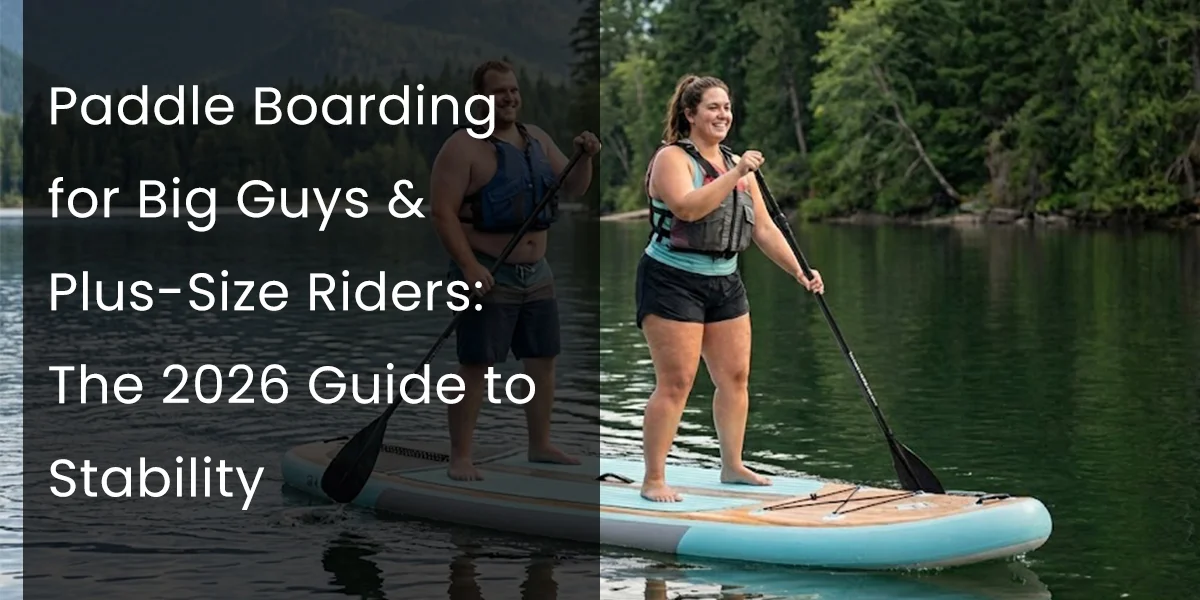
Let’s get right to the point: The paddle boarding business used to not care about bigger riders.
For years, marketing photographs solely showed 110lb models doing yoga. If you were a 6’2” rugby player or a plus-size woman, you were told to “purchase a 12-foot board” and hope for the best. Often, you ended up with damp feet, an unsteady board, and a damaged ego.
But this is 2026. Things have changed.
At Huale, we believe the water belongs to all. As a manufacturer, we realize that stability is a math problem, not a weight problem. If a board feels unstable, it’s not because you are too heavy; it’s because the board wasn’t constructed for your mass.
In this tutorial, we’re ignoring the conventional “weight loss” advice and focusing on the engineering that allows riders above 250lbs, 300lbs, or even 400lbs to paddle with great confidence.
The “Taco Effect”: Why Cheap Boards Fail Heavy Riders
Width is King (The 34″ Standard)
The width of a standard board is 32 inches. It can feel twitchy for a rider who weighs more than 220 pounds (100 kg). We suggest getting a board that is 34 inches wide.
- The Physics: The extra 2 inches of width make the surface area much bigger, like outriggers on a canoe. It makes a “wobbly tightrope” into a “stable sidewalk.”
Thickness: Never Go Below 6 Inches
You can’t change this. Adults don’t need 4-inch boards anymore.
- Why: A 6-inch board has 50% more air space than a 4-inch board. More air means more lift and less drag.
Volume (The Magic Number)
Look at the volume, which is measured in liters, not just the length.
- If you’re a heavy rider, you should get a board with at least 300L to 350L+ of volume. This keeps the board on top of the water, not in it.
Health Insight: Paddle boarding is one of the best low-impact exercises for larger bodies because it doesn’t stress the knees like running does. Source: Learn more about low-impact cardio benefits from the Mayo Clinic.
Getting On The Board (Without the Struggle)
A common old piece of advice was to “lose weight” to make paddling easier. We say, “Just change how you do it.”
If you have a big belly or aren’t very flexible, the “pop up” (jumping from your knees to your feet) can be hard.
- The Tripod Method: Keep your paddle on the deck as a “third leg” for balance.
- Wide Stance: Place your feet on the outer edges of the traction pad (wider than your shoulders).
- Momentum is Your Friend: It is actually easier to stand up while the board is moving slightly forward than when it is dead still.
Don’t Trust “Max Capacity” Labels Blindly
A lot of cheap brands on Amazon lie about their specs. They might say “Capacity: 400lbs,” but what they really mean is that the board won’t sink at that weight. It doesn’t mean it will stay the same.
The secret of the manufacturer is to always check the “Recommended Rider Weight” against the “Max Payload.”
- If you weigh 280 pounds, look for a board that can carry at least 400 pounds. You should always have extra space for your gear, cooler, or dog, just in case.
Check the latest safety regulations for weight capacity labels from the US Coast Guard Boating Safety Division.
Conclusion: The Water is For Everyone
In 2026, your size won’t stop you from getting in. The technology has caught up.
Big guys and girls can paddle just as hard as anyone else with high-pressure pumps, 34-inch-wide decks, and fusion drop-stitch materials.
Don’t accept a board that is wet and bendy. Switch to a platform that can handle power.
Check out our factory-direct collection of High-Capacity & Wide SUPs made just for riders who weigh more than 200 pounds.


