
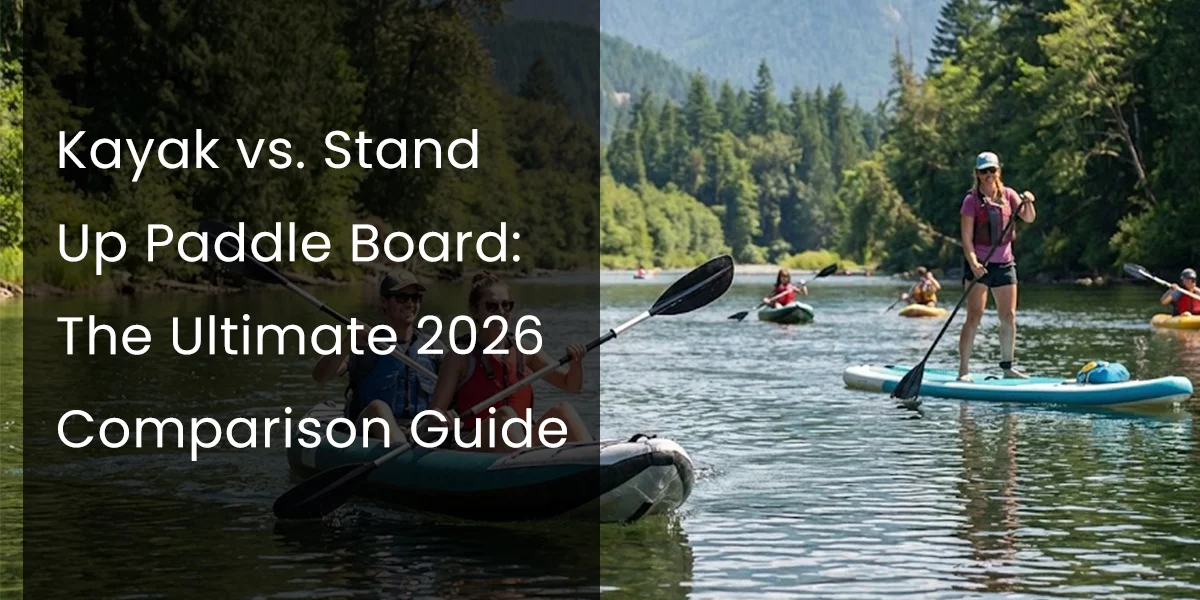
For everybody who loves water sports, the question is always: Should I buy a kayak or a stand-up paddle board (SUP)?
A few years ago, the answer seemed easy. You got a kayak if you wanted to sit and move quickly. If you wanted to play near the beach while standing up, you got a SUP.
But as we get closer to 2026, the lines have become less clear.
Huale has seen the industry change since they make high-end inflatable boats. The “cons” of paddle boarding are going away thanks to the rise of Hybrid Designs and ultra-rigid drop-stitch technology.
In this tutorial, we’ll look at the “Kayak vs. SUP” debate again, but with a modern twist. We’ll clear up old fallacies and help you pick the perfect boat for your needs.
The Core Difference: “Locked In” vs. “Freedom”
The key distinction, according to the old instructions, is whether you sit or stand. That’s true, but the main difference in 2026 is how easy it is to move.
- The Kayak Experience: You sit low, usually in a cockpit or molded seat. It is stable and works well, but your body stays in one place. After an hour, your hip flexors may feel tight.
- The SUP Experience: You have a “platform.” You can sit cross-legged, kneel, stand, or lie down for a sunnap.
- The 2026 Update: Modern SUPs are basically “floating yoga mats” or “casting platforms.” SUP is far better for your joints and core in the long run because you can move your body.
Health Fact: While kayaking is primarily an upper-body workout, SUP utilizes your entire kinetic chain, from your toes to your shoulders. Source: Read more about the full-body benefits of SUP from the American Council on Exercise (ACE).
Performance & Conditions: Who Wins in the Wind?
Old advise goes, “Kayaks are for rivers; SUPs are for lakes that are calm.” This is only partly true now.
Handling the Wind
It’s true: a standing paddler works like a sail. A low-profile kayak slices through the air easier when the wind is strong.
- But in 2026, “Touring SUPs” (like our 12’6″ versions) will have pointed displacement noses that cut through chop well, which will make the performance disparity less.
Visibility (The Fishing Advantage)
SUP is the clear winner for people who fish or appreciate nature. When you stand up, you can see through the water better and identify fish or reefs that a seated kayaker would miss.
Storage & Gear: The “Dry Bag” Revolution
Historically, kayaks triumphed on storage since they feature inside hatches. But look at the market in 2026. Modern touring SUPs now come equipped with dual cargo bungees (front and rear) and various D-ring tie-down points.
- The Verdict: Unless you are doing a multi-week polar expedition, a 12-foot touring SUP can easily carry a cooler, camping gear, and dry bags for a weekend trip.
Ease of Transport: The Death of the Roof Rack
This is where the fight is won and lost.
- Hard Shell Kayaks: They weigh more than 50 pounds, need a roof rack, and take up half of your garage.
- They roll up and fit in a bag or the trunk of a Tesla.
“But it takes too long to inflate!” We get this criticism from older articles. Let’s be honest: in 2026, almost everyone uses a 12V Electric Pump.
You plug it into your car and wait eight minutes while you put on sunscreen. Then your board is rock hard. The “setup time” argument is no longer valid.
The “Hybrid” Solution: Why Choose?
This is what kayak makers don’t want you to know: A Paddle Board can be a Kayak, but a Kayak can never be a Paddle Board.
Kayak Seat Conversion Kits are now standard on most of Huale’s inflatable SUPs.
- Clip a foam seat to the pre-installed D-rings.
- Swap your paddle handle for a second blade (creating a dual-blade kayak paddle).
- Boom: You are now kayaking.
In 2026, the best financial choice for you is to get a “Kayak-Ready SUP” if you can’t decide.
Safety Considerations
No matter what you choose, the safety of the water stays the same.
- Leash: Important for SUPs, but risky for river kayaking (risk of becoming stuck).
- Both must wear a PFD.
- Check the latest vessel safety requirements from the US Coast Guard Boating Safety Division.
Conclusion: The Manufacturer’s Verdict
So, should you buy or stock a kayak or a paddle board?
- If you only paddle in white water rapids, very cold waters, or very windy circumstances where you have to sit low to be safe, go with a kayak.
- Choose a SUP if you want to work out your whole body, have superior visibility, and be able to sit or stand.
The Inflatable SUP (with a kayak seat option) is the best investment for 90% of leisure users in 2026.
Are you ready to discover what hybrid paddling will look like in the future?
Check out Huale’s factory-direct Inflatable SUP & Kayak Hybrids.


