
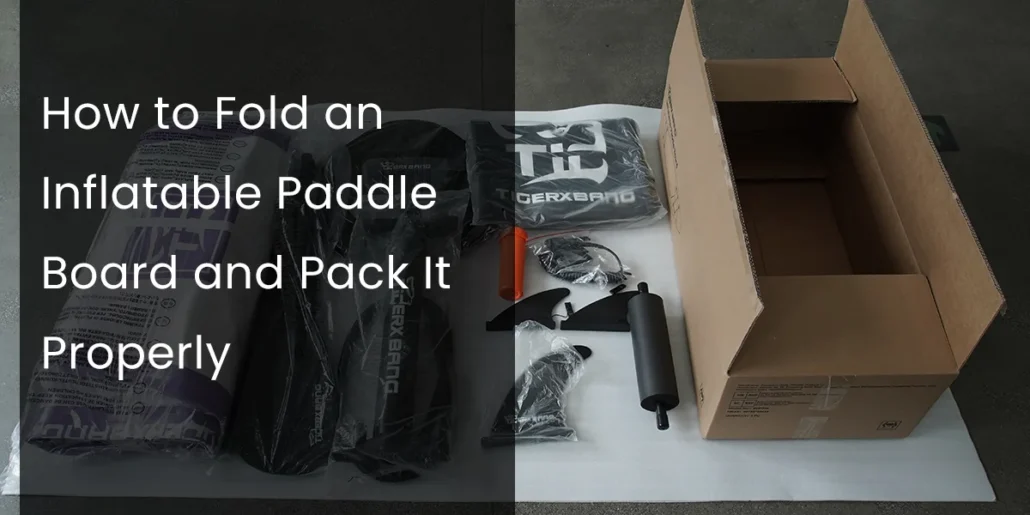
An inflatable paddle board should fit back into its carry bag without forcing the zipper, bending the fin box or trapping wet equipment against the board.
I’m Charlie from Huale. We manufacture inflatable SUP boards for brands, distributors, rental operators and outdoor retailers. From the product side, the most important packing rule is simple: the folding method must match the valve position, fin-box design and intended packing geometry of the actual board.
Short answer: rinse and dry the board, remove detachable accessories, release the air completely, fold or roll according to the board’s approved pattern, keep rigid fittings out of sharp fold lines, then secure the board before placing it into the bag.
Standard inflatable SUPs and compact travel SUPs do not always use the same folding pattern. Some boards roll from one end, while selected compact designs are built to fold lengthwise before being rolled or folded again.
This guide explains both methods and shows what to check before forcing a board into a smaller package.
How Do You Fold an Inflatable Paddle Board?
Use this five-step process as a general starting point:
- Clean and dry the board. Remove sand, salt and other debris before packing.
- Remove detachable parts. Take off the fin, leash and any accessories that should not remain attached during folding.
- Deflate completely. Open the valve according to the product instructions and allow the air to escape.
- Follow the approved fold pattern. Keep rigid parts such as the fin box and valve out of sharp fold lines.
- Secure and pack. Strap the folded board before placing it into the carry bag, then pack hard accessories so they cannot press directly against the board.
The exact direction of the fold is model-specific. A standard inflatable SUP may use a different sequence from a compact board designed around a split or foldable fin-box system.
If the board only fits when you force the final fold or pull heavily on the zipper, stop and check the fold pattern again.
Standard SUP vs Compact SUP: Why the Folding Method Can Be Different
The word “compact” does not describe one universal construction.
Some travel-oriented boards use lighter package components. Others use a board structure, fin-box system or fold line specifically designed to create a smaller packed shape.
| Board Design | Typical Packing Direction | Main Check |
|---|---|---|
| Standard Inflatable SUP | Usually folded or rolled along the board length according to the manufacturer’s instructions. | Do not create a sharp bend through a rigid fin box. |
| Longitudinal-Fold Compact SUP | May be designed to fold along the centerline before the remaining roll or fold. | Use this method only when the board construction was designed for it. |
| Foldable or Split Fin-Box System | Can support a different compact packing geometry. | Follow the approved fin-box folding direction and bag dimensions. |
This is why copying a folding video from another SUP model can create problems even when the two boards look similar when inflated.
For travel- and package-weight-oriented products, review our lightweight inflatable SUP range .
Standard SUP vs Compact SUP: Why the Folding Method Can Be Different
The word “compact” does not describe one universal construction.
Some travel-oriented boards use lighter package components. Others use a board structure, fin-box system or fold line specifically designed to create a smaller packed shape.
| Board Design | Typical Packing Direction | Main Check |
|---|---|---|
| Standard Inflatable SUP | Usually folded or rolled along the board length according to the manufacturer’s instructions. | Do not create a sharp bend through a rigid fin box. |
| Longitudinal-Fold Compact SUP | May be designed to fold along the centerline before the remaining roll or fold. | Use this method only when the board construction was designed for it. |
| Foldable or Split Fin-Box System | Can support a different compact packing geometry. | Follow the approved fin-box folding direction and bag dimensions. |
This is why copying a folding video from another SUP model can create problems even when the two boards look similar when inflated.
For travel- and package-weight-oriented products, review our lightweight inflatable SUP range .
What Should You Do Before Deflating and Folding the Board?
Packing starts before the valve is opened.
Check the board for:
- Sand and grit around the deck pad and fittings
- Salt residue after sea use
- Water trapped around handles, bungees or accessories
- Loose fins or removable hardware
- Visible cuts, abrasion or other damage that should be inspected before storage
Rinse the board with fresh water when required by the operating environment, then allow it to dry before it is enclosed in the bag for more than a short transport period.
Trapped grit can rub against the PVC, EVA or printed surfaces while the packed board moves inside a vehicle or shipping carton.
Remove detachable fins before folding unless the specific fin system is designed to remain in place during packing.
Accessories such as action-camera mounts, removable seats or other hard fittings should also be removed when they would create a concentrated pressure point inside the folded package.
How Should You Deflate an Inflatable SUP Before Folding?
First open the valve according to the board’s instructions and release the main internal pressure in a controlled area.
Once the pressure has dropped, smooth the board gently to move remaining air toward the open valve.
Some SUP pumps include a dedicated deflation connection. If the pump and valve system support that function, it can help remove residual air before compact packing.
Do not assume every hand pump has a deflation mode. Check the pump specification before attaching the hose to a different port or attempting to extract air.
The objective is not to create vacuum pressure inside the board. It is simply to remove enough remaining air that the product can follow its intended fold pattern without excessive resistance.
After the board is deflated, keep the valve area clean and follow the manufacturer’s valve-pin position and cap instructions before final packing.
Should You Roll or Fold an Inflatable Paddle Board?
Both methods can be correct. The answer depends on the board design.
For a Standard Inflatable SUP
Follow the fold or roll sequence supplied with the model. A common objective is to move remaining air toward the valve while preventing the rigid fin-box area from being sharply bent inside the roll.
For a Compact SUP
Some compact products use an additional longitudinal fold to reduce packed width. That fold should only be used when the board’s material layout, EVA deck, hardware and fin-box system were designed for it.
Why a Tight Fold Is Not Always a Better Fold
The smallest possible package is not automatically the correct package.
Excessive compression can place unnecessary stress on:
- Fin boxes
- Valve areas
- D-rings and mounts
- Thick EVA sections
- Rail overlaps and local reinforcements
The right target is a repeatable fold that fits the approved bag without forcing rigid components into unnatural positions.
How Do You Protect the Fin Box and Valve While Folding?
The fin box and valve are two areas that deserve extra attention because they are more rigid than the surrounding inflatable structure.
Fin Box
Remove the detachable fin first. Then position the fold so the rigid fin box is not forced directly across a sharp crease.
Depending on the board design, the fin-box section may remain on the outside or upper layer of the final folded package.
Valve
Do not use the valve body as a point for applying folding pressure. Keep hard accessories away from it when the board is packed into the bag.
Other Hardware
Handles, mounts, D-rings and reinforced cargo fittings should also be checked before creating a compact fold.
A fold that works on a plain all-round board may need adjustment on a fishing, touring or accessory-heavy SUP because the installed hardware is different.
How Should the Paddle, Pump, Fin and Accessories Be Packed?
The board is only one part of the complete SUP package.
A typical kit can include:
- Inflatable board
- Adjustable or multi-piece paddle
- Pump and hose
- Fin
- Leash
- Repair items
- Manual or instruction card
- Carry bag
Pack the folded board first when the bag was designed around that layout. Then place hard accessories into their assigned compartments or secure them so they cannot move against the board surface during transport.
Protect the fin blade, paddle adjustment mechanism and pump gauge from unnecessary pressure.
Do not place loose tools or hard repair components directly between tightly folded PVC layers.
Before closing the zipper, check that the bag closes under normal tension. The compression straps should control the package; the zipper should not be used to force an oversized fold into the bag.
Is the Best Packing Method Also the Best Long-Term Storage Method?
Not necessarily.
A compact fold is designed mainly for transport and space efficiency. Long-term storage introduces additional questions such as temperature, moisture, compression and how long the board remains in the same folded position.
For short-term transport:
- Use the approved fold pattern
- Keep the board clean and dry
- Secure hard accessories
- Protect the bag from sharp objects and excessive heat
For seasonal or warehouse storage, the storage environment and duration should be reviewed separately.
Huale currently has several SUP storage and maintenance resources covering overlapping topics. We recommend consolidating those pages into one storage guide before creating additional internal links from this article.
This page should remain focused on deflating, folding and packing rather than becoming another general SUP maintenance article.
Why Should Brands Test the Packing Method Before Bulk Production?
For a private-label or retail SUP, packing should be treated as part of the approved product specification rather than something decided after production.
A production-equivalent sample should be packed with the final:
- Board construction
- Fin system
- Paddle
- Pump
- Leash
- Repair kit
- Manuals and labels
- Backpack
- Retail or export carton
This allows the buyer to check whether the complete SKU fits without creating excessive pressure on the board or bag.
| Packing Check | What the Buyer Should Verify |
|---|---|
| Fold Pattern | Can staff or customers repeat it without bending rigid components? |
| Bag Fit | Does the complete board fit without using the zipper as a compression device? |
| Accessory Layout | Are the pump, paddle, fin and hard parts separated from vulnerable board areas? |
| Complete Package | Are gross weight and carton dimensions confirmed after all components are included? |
| User Instructions | Does the manual show the correct fold for the actual fin-box and valve layout? |
For e-commerce brands, this also matters because the customer expects the product to return to the supplied bag after use.
For lightweight and travel-oriented product programs, review our lightweight SUP specification guide .
For production, sample approval and quality-control information, see our inflatable paddle board factory page.
Common Mistakes When Folding and Packing an Inflatable SUP
- Copying another board’s fold pattern: the valve, fin box and hardware positions may be different.
- Folding before enough air has escaped: remaining air makes the package larger and can make the fold harder to control.
- Assuming every pump can extract air: use a deflation port only when the pump was designed for that function.
- Creating a sharp fold through the fin box: rigid components should not be forced into a tight crease.
- Packing the board while wet for extended storage: allow the board and bag to dry before long-term packing.
- Leaving loose hard accessories against the PVC or EVA: secure them in the correct compartment or protective position.
- Using the bag zipper to compress the board: if the bag only closes under heavy force, reopen it and check the folding sequence.
- Using the smallest possible fold as the goal: compact packing should not come at the expense of the board’s rigid fittings or approved construction.
FAQ: Folding and Packing an Inflatable Paddle Board
Should you roll or fold an inflatable paddle board?
Both methods can be correct. Standard boards may use a lengthwise roll or fold, while selected compact SUPs are designed for an additional longitudinal fold. Follow the method approved for the exact valve, fin-box and hardware layout of your board.
Do I need to remove all the air before folding an inflatable SUP?
Remove enough air for the board to lie flat and follow its intended folding pattern without resistance. Some compatible pumps can help remove residual air through a dedicated deflation port, but not every pump supports this function.
Can I fold an inflatable paddle board over the fin box?
Avoid forcing a sharp crease directly through a rigid fin box. Remove the detachable fin and position the fin-box section according to the board’s packing instructions. Compact boards with specially designed folding fin systems may use a different method.
Should an inflatable paddle board be completely dry before packing?
For normal transport, remove excess water and debris. Before the board is enclosed for extended storage, allow the board and bag to dry. This also gives you an opportunity to inspect the PVC, EVA, valve and fittings before the next session.
Why does my inflatable paddle board no longer fit into its bag?
Common causes include residual air, an incorrect fold pattern, accessories placed in the wrong position or a fold that does not account for the fin box and other rigid fittings. Reopen the board and repeat the model-specific packing sequence instead of forcing the zipper.
Developing a Compact or Travel SUP Package?
For brands and distributors, packed size should be confirmed on the production-equivalent sample together with the board, pump, paddle, fin, leash, backpack and retail packaging.
Review our lightweight inflatable SUP options or our SUP manufacturing and sample process if compact packing is part of your product specification.
Sample availability and bulk-order requirements depend on the selected board, construction, accessories and packaging.
We will respond within 24 hours with a factory-direct quote.