
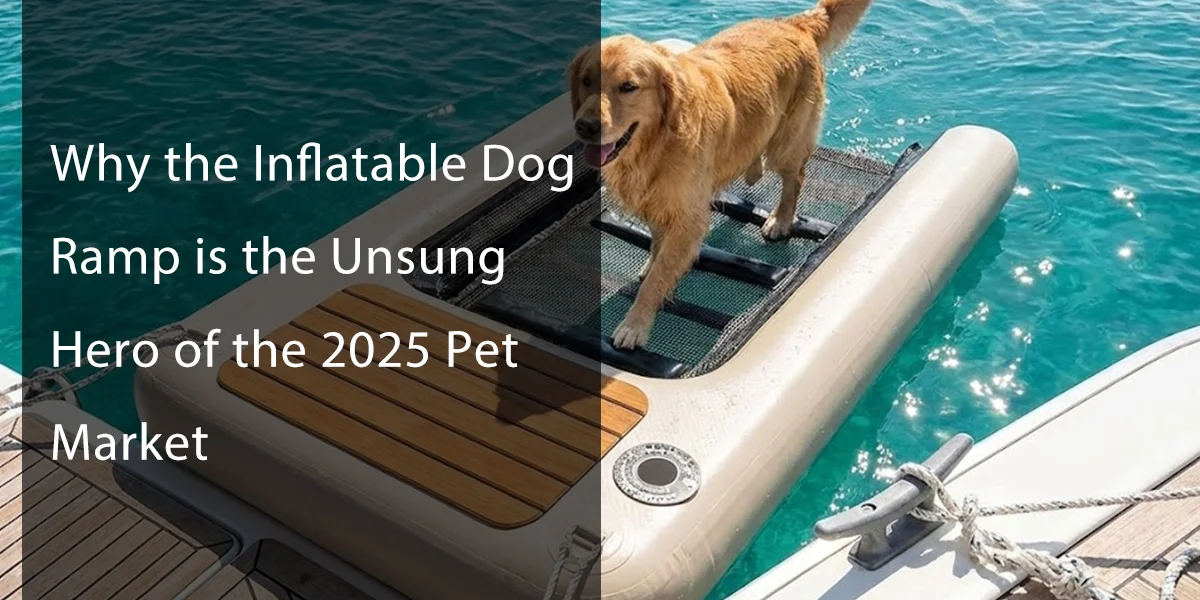
If you look at the sales data for marine accessories, one category is quietly outperforming the rest: Pet Safety Water Ramps.
According to the American Pet Products Association (APPA), pet spending has shifted from “necessities” to “lifestyle integration.” Dog owners aren’t just walking their pets; they are taking them boating, kayaking, and dock diving.
But here’s the problem: it’s unsafe for the dog and hard on the owner’s back to get a wet, tired Golden Retriever back onto a pontoon boat or swimming platform.
As a maker of drop-stitch solutions, I’ve seen a lot more OEM requests for inflatable dog ramps. Making things for paws is different than making things for feet, though.
To do well in this niche, you need a product that can handle claws, currents, and doubt. This is the industrial plan for making a ramp that sells itself.
The “Claw Factor”: Engineering for Durability
“Punctures” is the most common reason people leave bad reviews on Amazon for pet ramps. PVC made for human skin is used in a conventional inflatable paddle board.
A dog ramp has to be able to handle sharp keratin claws pressing in for traction.
The Huale Solution: We don’t utilise regular SUP material here. We use a Heavy-Duty 1000D Reinforced PVC and a unique EVA Traction Pad together.
- The EVA Layer: This isn’t simply for grip; it’s also a shield that can be used up. We employ a diamond-groove or brushed texture that lets claws grip without going through the air chamber underneath.
- The Rail Band: We put double-layered tape on the rails because dogs often scramble to the edges when they are scared.
Stability Physics: Weighted Mesh vs. Floating Steps
A ramp that floats too well is actually a failure. If the bottom of the ramp floats on the surface, the dog cannot climb onto it. It needs to sink slightly to create an approach angle.
The Design Secret: We use Weighted Mesh Steps in the design.
- Water Capture: The mesh steps fill with water, which keeps the ballast in place.
This makes the entry point lower than the water level, so the dog can swim onto the ramp instead of having to lift themselves up to it. - Counterweight: We make special ballast bags or stainless steel D-ring weights for the bottom of the ramp to keep it from toppling over when weight is put on it for bigger breeds like German Shepherds and Labs.
Versatility: One Ramp, Multiple Scenarios
To maximize your Total Addressable Market (TAM), your product shouldn’t just work on a boat. We design our Inflatable Dog Ramps with a universal D-ring and rope system.
- Pool Use: It attaches to pool ladders for safe exit.
- Dock Use: It ties off to standard cleats.
- Boat Use: It secures to the transom or gunwale.
You may attract pool owners, boaters, and dock users all at once by providing a flexible attachment method.
Logistics for Amazon Sellers (FBA Optimization)
Size of the package is very important for our B2B partners who sell on Amazon. Shipping rigid plastic ramps is a nightmare because they are big and cost extra to store.
The Inflatable Edge: Our drop-stitch ramps can be deflated into a box that is about the size of a shoebox or a small backpack.
- High Density: You can fit 500-800 units in a container.
- Lower FBA Fees: The small footprint drastically reduces your fulfillment costs compared to selling rigid plastic ramps.
Conclusion: Capture the “Pet Parent” Market
Pet owners will spend whatever it takes to keep their “fur babies” safe, hence the demand for pet safety gear is inelastic.
Don’t settle for selling cheap, thin-walled ramps that break after one season. Work with a factory that knows how pets move and how materials work.
Are you ready to make a prototype of your brand’s pet ramp?
Get in touch with Huale Engineering today. We may change the colour of the EVA pad, where the branding goes, and the packaging to make a high-end product that is ready for sale in 2025.