
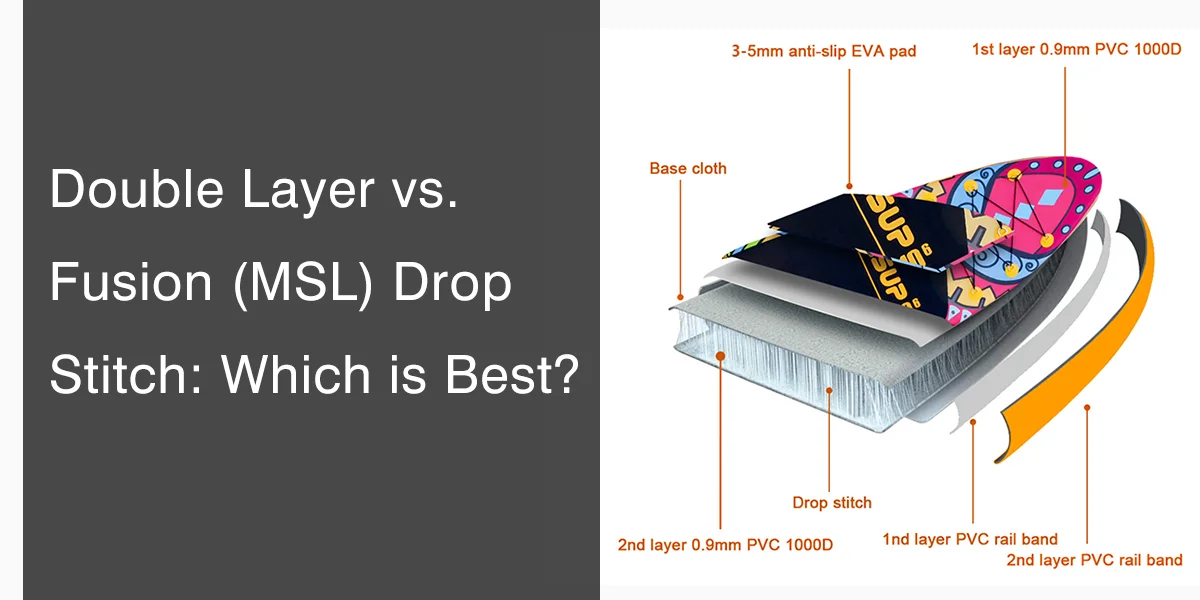
Double-layer and fusion-laminated drop stitch are two common construction approaches used in inflatable SUP production, but the difference is often oversimplified into “heavy versus light” or “old versus new.”
I’m Charlie from Huale. We manufacture inflatable paddle boards for distributors, private-label brands, rental operators and e-commerce sellers. From a production perspective, construction should be selected according to the complete board specification rather than one material label.
Short answer: traditional double-layer construction adds a separate reinforcement layer using an adhesive-based lamination process, while fusion construction integrates additional reinforcement through a controlled factory lamination process. Fusion construction can reduce adhesive-related weight and improve production consistency, but the finished board’s stiffness, weight and durability still depend on the drop-stitch core, coating, rail construction, board geometry and operating pressure.
One terminology point is also important: MSL® should not be used as a generic synonym for every fusion SUP construction. It is a brand-specific construction name. In this guide, we use “fusion” or “fusion-laminated construction” for the broader manufacturing category.
This article explains how B2B buyers should compare the two constructions before approving a private-label SUP specification.
For complete OEM production capability, see Huale’s inflatable paddle board factory page.
Double Layer vs Fusion Drop Stitch: What Is the Main Difference?
The main difference is how the reinforced outer layer is integrated with the drop-stitch base material.
| Comparison | Traditional Double Layer | Fusion-Laminated Construction |
|---|---|---|
| Reinforcement Process | A separate reinforcement layer is bonded to the base material using an adhesive-based process | Reinforcement is integrated through a controlled factory lamination process |
| Adhesive Contribution | Additional adhesive is part of the lamination system | Can reduce the amount of separately applied adhesive in the body laminate |
| Finished Weight | Can be heavier when otherwise comparable constructions are used | Can support lower-weight construction, depending on the complete specification |
| Process Consistency | More dependent on adhesive application and process control | Factory lamination can improve repeatability when the process is properly controlled |
| Best Choice? | Depends on price point, construction and application | Depends on weight target, performance requirement and product positioning |
These are construction tendencies rather than universal performance guarantees. Buyers should compare finished boards using the same dimensions, pressure and test conditions.
Is Fusion Drop Stitch the Same as MSL?
Not exactly.
“Fusion” is commonly used in the inflatable SUP industry to describe a machine-laminated construction in which reinforced layers are integrated with the drop-stitch base material during material production.
MSL® stands for Monocoque Structural Laminate and is a proprietary construction term associated with Red Paddle Co.
This distinction matters for B2B sourcing because suppliers sometimes use well-known market terminology to describe broadly similar constructions even when the material supplier, laminate structure and production specification are different.
When comparing SUP factories, do not ask only:
“Do you have MSL?”
Instead ask:
- What is the drop-stitch core construction?
- How are the outer layers laminated?
- What coating and reinforcement structure is used?
- How are the rails constructed?
- What is the finished board weight for the approved size?
- What operating pressure applies to the finished model?
A construction name is useful for communication, but the approved product specification is what should control the purchase order.
How Is a Traditional Double-Layer SUP Constructed?
Traditional double-layer construction starts with a drop-stitch base material and adds a separate reinforcement layer over the board body.
In a conventional adhesive-based process, the reinforcement material is bonded to the underlying layer using adhesive before the material becomes part of the finished SUP structure.
From a manufacturing perspective, important control points include:
- Surface preparation
- Adhesive application consistency
- Layer alignment
- Temperature and curing conditions
- Material storage
- Finished laminate inspection
The main sourcing issue is therefore not that “glued double layer is bad.” A properly controlled construction can still produce a usable commercial product.
The limitation is that adding a separate bonded layer introduces additional material, adhesive and process variables that can affect weight and production consistency.
How Does Fusion-Laminated Drop Stitch Construction Work?
Fusion construction changes how the reinforced outer material is integrated with the drop-stitch substrate.
Instead of applying a complete second layer manually during finished-board production, the reinforced material is prepared through a controlled lamination process before it is cut and assembled into the board.
For B2B buyers, the practical advantages may include:
- Reduced reliance on manually applied adhesive across the main board panels
- Lower material weight in some comparable constructions
- More consistent laminate appearance
- More repeatable material preparation
- Potentially easier development of lightweight product lines
However, “fusion” does not tell the buyer everything about the finished SUP.
Two fusion boards can still use different drop-stitch cores, coatings, rail structures, dimensions, EVA coverage, fittings and reinforcement strategies. Their finished performance can therefore be different even when both suppliers use the same general construction label.
Are Fusion SUP Boards Always Lighter Than Double-Layer Boards?
Fusion construction can reduce weight because it can reduce the amount of separately applied adhesive used to create the reinforced body laminate.
But buyers should not use a universal percentage such as “20% lighter” without comparing the exact boards.
Finished SUP weight can also be affected by:
- Board length, width and thickness
- Drop-stitch core type
- PVC or coating specification
- Rail reinforcement
- EVA deck coverage
- Handles, D-rings and mounts
- Fin-box construction
- Additional reinforcement areas
The correct B2B comparison is therefore:
same board geometry + comparable accessories + comparable intended use + different construction system.
Ask the supplier for the finished sample weight rather than relying only on a material-name claim.
For brands developing a weight-sensitive product line, see our lightweight inflatable SUP board options.
Is Fusion Construction Stiffer Than Traditional Double Layer?
Construction can influence stiffness, but stiffness cannot be compared responsibly from the terms “fusion” and “double layer” alone.
Board stiffness also depends on:
- Board thickness
- Length and width
- Drop-stitch thread or woven structure
- Material tension
- Rail construction
- Operating pressure
- Load and test position
If two suppliers provide stiffness data, ask whether the boards were tested under the same conditions.
A meaningful comparison should control variables such as:
- Board dimensions
- Inflation pressure
- Support positions
- Applied load
- Measurement point
Without those conditions, statements such as “30% stiffer” or “very high rigidity” are difficult for a purchasing team to verify.
Which SUP Construction Is More Durable?
There is no responsible answer based on the body-lamination method alone.
Long-term SUP durability can be affected by:
- Base drop-stitch material
- Outer coating and reinforcement
- Rail construction
- Valve installation
- Operating pressure
- UV and heat exposure
- Storage conditions
- Repeated folding
- Transport and handling
- Repair history
Traditional adhesive-based double-layer construction introduces an additional bonded interface that needs controlled application and curing. Fusion lamination can reduce that particular production variable, but it does not eliminate every possible source of delamination, seam damage or product failure.
For B2B buyers, durability should be evaluated using the supplier’s approved construction, sample performance, QC process and relevant production history rather than a statement that one material “cannot delaminate.”
Fusion Construction and Welded Rails Are Not the Same Thing
Another common sourcing mistake is treating body construction and rail construction as one technology.
They are separate parts of the SUP specification.
Fusion or double-layer construction mainly describes how the large top and bottom drop-stitch panels are reinforced.
Rail construction describes how the sidewalls and sealing layers around the perimeter of the board are assembled.
A supplier may therefore offer combinations such as:
- Fusion body material with adhesive-based rail construction
- Fusion body material with a welded rail system where the selected materials and process allow it
- Traditional double-layer body material with a different rail reinforcement structure
Do not assume that the word “fusion” automatically means the entire finished board is welded without adhesive.
When requesting a quotation, ask the supplier to specify the body laminate and rail construction separately.
Double Layer vs Fusion SUP: B2B Purchasing Comparison
| Buyer Factor | Traditional Double Layer | Fusion-Laminated |
|---|---|---|
| Weight Control | Additional adhesive and reinforcement can increase finished weight | Can support lighter specifications when otherwise comparable |
| Material Process | Separate reinforcement layer bonded using adhesive-based processing | Reinforcement integrated during controlled material lamination |
| Consistency | Strongly dependent on adhesive preparation and application control | Can reduce variation associated with manual full-panel adhesive application |
| Stiffness | Can achieve high stiffness depending on the complete construction | Can achieve high stiffness while supporting lower-weight designs, depending on specification |
| Cost | Depends on material, labor, order size and construction | Material may cost more, but final FOB depends on the complete board and production process |
| Best B2B Fit | Projects where the approved specification and commercial target support the construction | Weight-sensitive retail, touring, DTC or premium private-label projects where specification supports it |
The table should be used as a sourcing framework rather than a performance guarantee. The final decision should be made from the approved board specification and sample.
Should Rental Fleets Choose Double Layer or Fusion SUPs?
Rental buyers should not automatically select traditional double layer because it feels heavier, nor automatically select fusion because it is newer.
A rental operator should evaluate:
- Daily handling and carrying distance
- Frequency of inflation and storage
- User skill level
- Expected surface wear
- Repair process
- Board replacement cycle
- Staff handling requirements
- Cost of spare inventory
A lighter board can reduce manual handling effort, while another buyer may prioritize a particular construction because it already matches an established repair and maintenance system.
The better choice should therefore be based on the complete fleet economics rather than simply choosing the heavier board as the “more durable” option.
Why Construction Matters for DTC and Retail SUP Brands
For a retail or e-commerce brand, construction affects more than on-water performance.
Finished board weight can also influence:
- Customer carrying experience
- Backpack design
- Parcel or fulfillment economics in some channels
- Product-page specifications
- Return expectations
- Competitive product positioning
However, buyers should calculate logistics using the final packed product, not board weight alone.
A lighter SUP may still use a larger carton or heavier accessory package. For sea freight, container utilization can also be constrained by packed volume rather than product weight.
That is why the construction decision should be connected to packaging and channel economics instead of assuming that every kilogram saved produces the same freight saving.
What Should a SUP Buyer Put on the Construction Specification Sheet?
Do not allow the purchase order to describe the product only as “fusion SUP.”
A more useful specification should identify:
- Board dimensions
- Drop-stitch core type
- Body laminate construction
- Outer coating or reinforcement specification
- Rail construction
- Valve type
- Fin-box system
- EVA deck configuration
- Handles, D-rings and mounts
- Approved operating pressure
- Finished board weight or agreed weight control where applicable
- Graphics and logo files
- Accessory package
- Packaging
Terminology should be supported by the actual specification. If two factories both write “fusion construction” but quote different material structures, the buyer is not comparing equivalent boards.
For a broader view of drop-stitch structure and production control, review our precision drop stitch engineering guide.
How Should Buyers Compare Double-Layer and Fusion SUP Samples?
The strongest construction decision is made from comparable physical samples rather than supplier adjectives.
Where practical, compare:
- Finished dimensions
- Board weight
- Surface and laminate appearance
- Rail workmanship
- Valve and fin-box installation
- EVA alignment
- Inflated board shape
- Stiffness under a defined comparison method
- Air retention according to the approved model-specific process
- Folded and packed configuration
If stiffness is important, use the same board dimensions, inflation pressure, support arrangement and applied load for both samples.
If weight is important, weigh the bare board separately from the paddle, pump, bag and other accessories.
The approved construction sample should then be connected to a written specification and artwork revision before bulk production.
Does Fusion Construction Always Cost More?
Not necessarily in the same way for every project.
Fusion-laminated material may carry a different raw-material cost, while traditional double-layer production includes additional adhesive and processing requirements.
The final SUP quotation also depends on:
- Board size
- Drop-stitch core
- Rail construction
- EVA deck
- Graphics
- Fins and fittings
- Accessory package
- Packaging
- Order quantity
For B2B comparison, ask suppliers to quote the same dimensions, construction scope and accessories.
A price difference cannot be attributed to “fusion versus double layer” if the two quotations also use different rails, fins, paddles, pumps or packaging.
Which SUP Construction Should You Choose for a Private-Label Product Line?
There is no single construction that should be used for every private-label SUP.
A buyer developing a lightweight retail or touring product may prioritize lower finished weight and consistent material preparation. A rental or value-focused program may place different weight on purchase cost, repair workflow and existing fleet specifications.
The practical sequence is:
- Define the target customer and sales channel
- Set the required board geometry and performance direction
- Compare appropriate construction options
- Review physical samples
- Confirm the approved construction on the product specification
- Use that reference for bulk QC
For bulk product planning, review our wholesale paddle boards page.
For OEM material selection and manufacturing review, see our inflatable SUP factory capabilities.
Common Sourcing Mistakes When Comparing SUP Construction
- Using MSL as a generic name for every fusion board: brand-specific terminology should not replace the actual material specification.
- Assuming fusion automatically means welded rails: body lamination and rail construction are separate parts of the SUP design.
- Assuming a heavier board is automatically more durable: weight alone does not describe material quality, seam construction or service life.
- Comparing stiffness at different pressures: the result is not useful unless the main test conditions are controlled.
- Accepting universal weight-saving percentages: the difference depends on board size and the complete construction.
- Comparing FOB prices without matching specifications: rails, EVA, fins, accessories and packaging may explain part of the difference.
- Approving “fusion construction” without a written material specification: the same marketing term can describe different supplier constructions.
FAQ: Double Layer vs Fusion Drop Stitch SUP Construction
What is the difference between double-layer and fusion SUP construction?
Traditional double-layer construction adds a separate reinforcement layer using an adhesive-based bonding process. Fusion construction integrates reinforcement through a controlled material-lamination process. The finished performance still depends on the complete drop-stitch core, rail construction, dimensions and operating pressure.
Is MSL the same as fusion drop stitch?
MSL® is a brand-specific construction term rather than the generic name for all fusion SUP materials. In B2B sourcing, buyers should ask for the actual drop-stitch, laminate and rail specifications instead of assuming every supplier using “fusion” is offering the same construction.
Are fusion SUP boards always lighter than double-layer boards?
Fusion construction can reduce weight associated with a separately bonded reinforcement layer, but the final board weight also depends on dimensions, drop-stitch core, rails, EVA, fittings and additional reinforcement. Compare finished samples rather than relying on a universal percentage.
Is fusion construction always more durable than glued double layer?
Not automatically. Fusion lamination can reduce some process variables associated with full-panel adhesive application, but long-term durability also depends on materials, rails, valves, pressure, storage, UV exposure and handling. Buyers should evaluate the complete construction and QC process.
What should I ask a SUP factory before choosing a construction?
Ask for the drop-stitch core type, body laminate, rail construction, finished board weight, operating pressure, sample specification, QC method, accessories and packaging. Compare suppliers using the same board geometry and product requirements.
Conclusion: Compare the Construction Specification, Not the Marketing Name
Traditional double-layer and fusion-laminated SUP construction use different approaches to reinforcing the drop-stitch body, but neither term defines the complete quality of a finished paddle board.
Fusion construction can support lower-weight and more repeatable material preparation, while traditional double-layer construction can still be appropriate when it matches the buyer’s approved product and commercial requirements.
For B2B buyers, the most important step is to move beyond labels such as “double layer,” “fusion” or “MSL” and compare the actual construction specification.
Confirm the drop-stitch core, laminate, rails, dimensions, operating pressure, finished weight and QC process, then evaluate comparable samples before freezing the bulk-production specification.
For OEM construction development, review Huale’s inflatable paddle board manufacturing capabilities.