
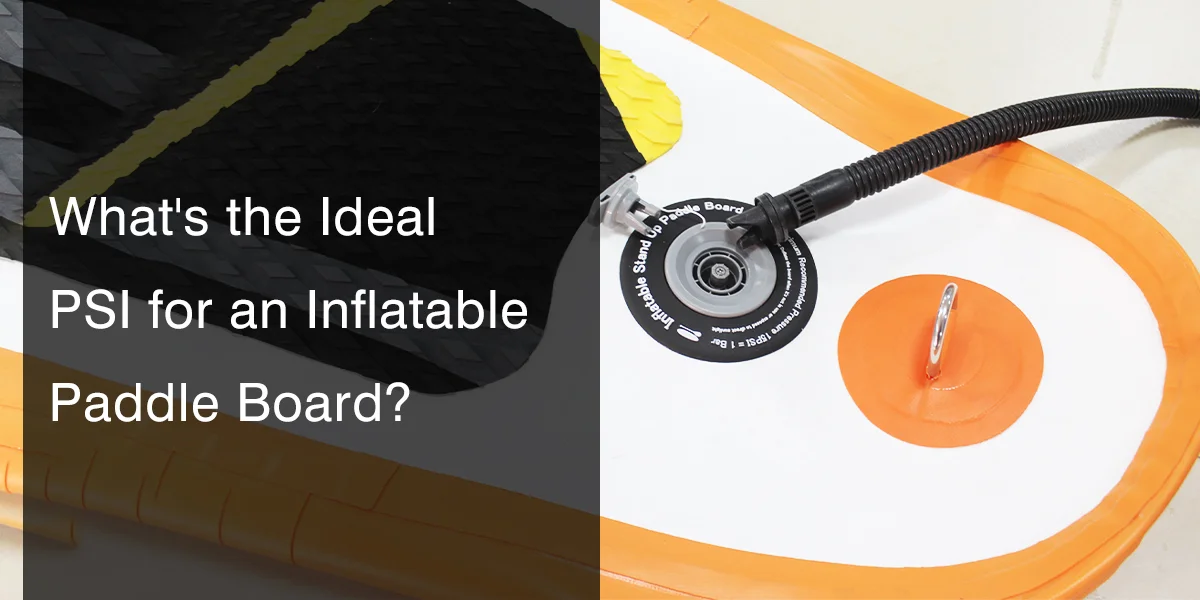
If I had a $1 for every time a consumer enquired, “Will it blow up if I pump it too much?” I could definitely quit making inflatable things.
It’s a real dread. You are standing over your board, sweating, and watching the gauge slowly move past 12 PSI. The board feels like it is rock hard. Your gut tells you to stop, but the book reads “15 PSI.” Who do you have faith in?
In the fifteen years I’ve spent stress-testing drop-stitch fabrics, I’ve learnt that “Ideal PSI” isn’t a fixed number; it’s a balance that changes based on the weight of the rider, the water conditions, and the temperature outside.
The 15 PSI that is customary in the industry is a safe starting point, but knowing how that number was made is the key to getting better performance and making your board last longer.
The “Taco Effect”: Why Pressure Equals Performance
You need to know what drag is in order to understand pressure. An inflatable board gets its strength from the air pressure inside it.
If you under-inflate your board—say, stopping at 10 or 11 PSI because your arms got tired—you invite the dreaded “Taco Effect.” This occurs when the board sags in the middle under your weight.
According to principles of hydrodynamic drag, this distortion drastically increases water resistance. You aren’t gliding; you are pushing water.
My Rule of Thumb:
- Light Riders (<70 kg): You can usually get away with 12 to 13 PSI. The board won’t bend much when you stand on it, and pumping saves you energy.
- Heavy Riders (>90 kg): You should press for 15 to 18 PSI. You need that extra internal strain to keep your stance from pushing you down.
The Sun is Your Enemy (Charles’s Law in Action)
This is the situation that destroys more boards than sharp rocks: In the cool morning air (20°C), you pump your board up to a rock-hard 18 PSI.
After that, you take a break for lunch and leave the board on the scorching asphalt in the direct sun for the rest of the day (35°C+).
Physics takes over. Specifically, Charles’s Law dictates that gases expand when heated.
We have witnessed internal pressure rise by 3 to 6 PSI solely from solar heating in our manufacturing testing chambers.
The seams are under a lot of stress and the glue is being tested to its utmost on that ideal 18 PSI board, which is now at 24 PSI.
If you’re not careful, this could cause a seam to break or a hull to twist.
The Expert Protocol: “Burp” your board if you are leaving it out of the water in direct sunshine. Let out a little air to lower the pressure to 10 to 12 PSI. It simply takes 30 seconds to fill it up again before your next session, yet it preserves the materials from years of wear.
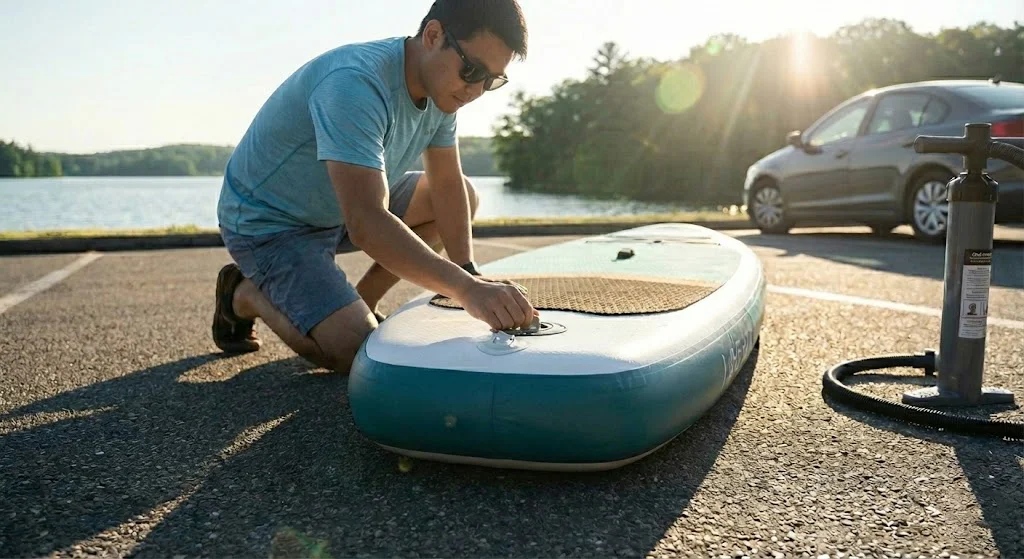
Not All Boards Can Handle the Pressure
Why do some companies state their boards can handle 20 PSI, but others (like Huale) say they can handle 12 PSI?
The density of the manufacturing is what matters. Cheap, single-layer boards have drop-stitch threads that are less dense. If you blow them up too much, they lose their flat shape and start to look like a round sausage.
Fusion (Machine Laminated) Technology makes high-quality boards that are more stronger when pulled. The mechanical bond is stronger than the material itself because the layers are fused together instead of bonded. In the lab, we regularly test our fusion boards to 25+ PSI without any problems.
You don’t have to ride at 25 PSI, but knowing that your board has that safety margin makes you feel better when you pump it up to a hard 18 PSI for a race or a long-distance tour.
Final Verdict
So, what’s the number that works?
For 90% of riders, 15 PSI is the best pressure for a board made using fusion construction. It has the hardness of a hard board without putting too much stress on the seams.
But don’t be frightened to change. If the water is rough or you have a lot of camping gear, up the pressure to 17–18 PSI for more stability. Keep the golden rule in mind: let some air escape when the board gets out of the water and into the sun.


